

The infraorbital zone is not an aesthetic canvas that simply gets “dirty”; it is a tissue window with a thickness of barely 0.5 millimeters that reveals the efficiency—or the alteration—of your microcirculation and your bone structure. Before applying an external substance, it is advisable to identify which internal process is altering the clarity of your skin.
By Ehab Soltan
HoyLunes — There is a brief, almost automatic moment when you look at yourself in the mirror without thinking too much. You aren’t analyzing anything. You just look. And, without realizing it, you make a quick diagnosis: “I’m tired”.
You don’t question it. You don’t explore it. You accept it as a sufficient explanation. Perhaps you decide to sleep more, drink more water, or change your cream. Perhaps you do nothing. But what you see the next day is still there. Then you begin trying to correct it, rather than understand it.
And in that small gesture—so everyday it goes unnoticed—something important happens: you confuse a signal with a defect. Because what appears under your eyes is not always a lack of rest. Sometimes it is something else. And it is almost never interpreted correctly.
If you look in the mirror and label what you see simply as “fatigue”, you are simplifying a complex biological process. Evidence in dermatology suggests that what we colloquially call “dark circles” can reflect changes in the skin barrier, circulation, or facial structure. It is not an isolated aesthetic problem. Most importantly: not all dark circles tell the same story. It is an infraorbital system operating under interferences that you rarely perceive.
The Error of the Single Cause
Dermatological literature has documented that the periorbital region is one of the most sensitive to systemic changes due to its low density of sebaceous glands and collagen fibers. However, the most common error is treating every shadow under the eye as a sleep deficit.
Studies published in journals such as the Journal of Cosmetic Dermatology suggest that the marked appearance of this area is not a pathology, but rather an intersection of mechanisms. If you treat a structural hollow with a superficial cosmetic product, you are not failing due to a lack of consistency, but due to a lack of diagnosis.
Three Mechanisms Redefining Your Gaze
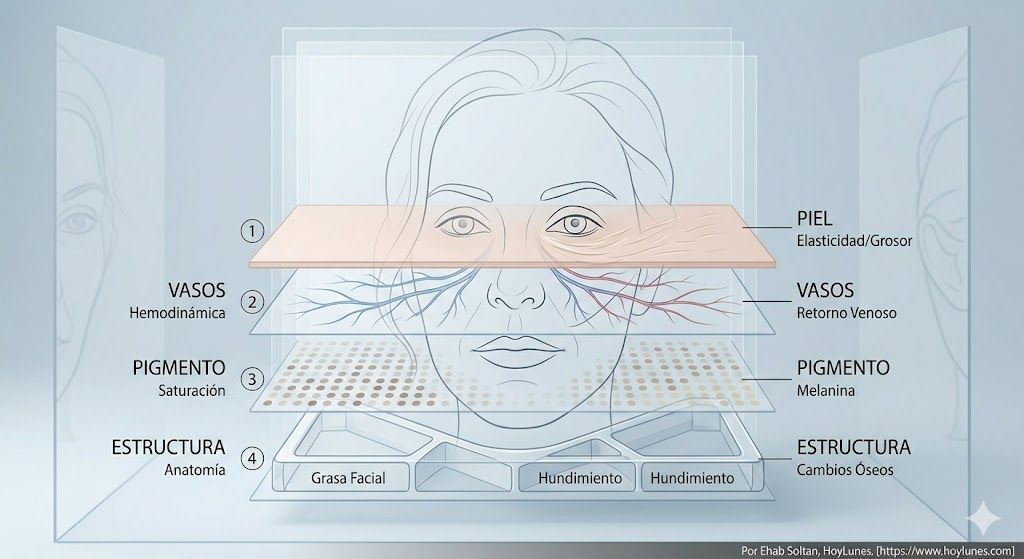
To “unclog” the gaze, it is useful to classify which processes are preventing light from reflecting uniformly:
Slowing of Venous Return (Venous Stasis): It’s not color; it’s fluid dynamics. When circulation slows down—due to digital eye strain or prolonged head positioning—the vessels dilate. In such thin skin, this can be perceived as bluish tones. Here, the problem is not the skin; it is the flow.
Cumulative Response (Hyperpigmentation): Here the mechanism is an excess of melanin. Constant friction (due to allergies or tics) generates a cumulative skin response to irritation or sun exposure. The brown tone is the visible record of a friction habit or unprotected sun exposure.
Changes in Bone Structure (Shadows): This is the factor that cosmetics rarely solve. Over time, progressive changes occur in the bone structure along with a displacement of facial fat compartments. As support is lost, a hollow is created. What you see is not a stain; it is a physical shadow caused by anatomy.

The Impact of the Ultra-Connected Life
We cannot ignore the relationship between our biology and the environment. Prolonged use of electronic devices has been associated with markers of oxidative stress in the skin.
When you spend hours in front of a monitor, your extraocular muscles demand a constant blood flow, which can promote sustained vasodilation that shows through the skin. In this scenario, rather than “brightening” the area, you need to reduce the metabolic demand of your eyes.
The “Eye Detox” Fallacy
There is a belief that dark circles are accumulated “toxins”. Clinical physiology is more sober: they are metabolites and fluids that may not be efficiently drained by the facial lymphatic system.
Infraorbital health is not built by adding layers, but by eliminating the stressors that degrade elastin.
If cortisol is chronically elevated due to perceived stress, it can affect the repair capacity of peripheral tissues like the eye contour. The result is skin that becomes thinner and, therefore, more transparent to what is happening beneath.
The Limit of Intervention
It is fundamental to understand that facial structure varies. Women often report greater concern for this area, frequently due to skin that tends to be thinner and hormonal changes that influence fluid retention.
However, from the fourth decade onwards, the predominant factor is collagen loss. Attempting to reverse through topical products what is a natural bony reconfiguration is to overlook the biological limits of facial structure.

The Unclogging Model
The question is not which product to choose. The question is which habit is obstructing your facial balance.
If the origin is vascular: Unclog the flow by prioritizing circadian rest.
If the origin is pigmentary: Stop the aggression by eliminating friction and protecting the area from the sun.
If the origin is structural: Acknowledge the anatomical component and adjust your expectations to the limits of your structure.
The gaze is not corrected: it clears when you stop interfering with the processes that sustain it.
Are you trying to hide the shadow or understand the mechanism projecting it?
#ScientificDermatology #FacialPhysiology #VisualHealth #HoyLunes #EhabSoltan